Remembering Janet Witkin, Shared Housing Pioneer
"People don't have to live alone, and they don't have to live in institutions."
When I was just starting out in the field of senior services in the mid-1980s, I attended a housing conference and met a woman who would quietly reshape how many of us thought about growing older.
Her name was Janet Witkin. She was a former teacher who founded Alternative Living for the Aging (ALA) in Los Angeles in the late 1970s. Brimming with warmth, modesty, humor, and fierce passion for her work, Janet was decades ahead of her time.
The idea for ALA grew out of her experience caring for her own grandfather and seeing the stark, rigid choices available to older adults. As her organization’s mission evolved, Janet became one of the earliest advocates for what we now celebrate as aging in place, shared housing, and naturally occurring support networks.
Her words: “People don’t have to live alone, and they don’t have to live in institutions” may be the single sentence that best captures her revolutionary philosophy.
The Problem She Was Trying to Solve
In the 1970s, Janet saw that society offered older adults only two stark choices: remain isolated at home or enter an institution and lose a significant degree of autonomy.
She was openly critical of unnecessary institutionalization, famously noting that "people are ripped off of their functions." She argued that older adults often lost their independence not because they were incapable, but simply because no reasonable alternatives existed.
Throughout her career, Janet repeatedly proved that independence and community are not opposites. Her goal was to help people remain independent through interdependence.
Three Pioneering Housing Experiments
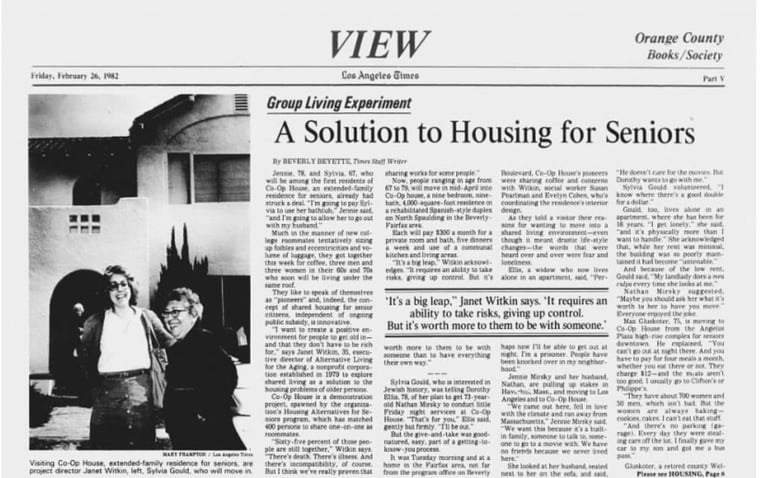
By the early 1980s, ALA was operating several groundbreaking housing models in Los Angeles that serve as the template for alternative housing today.
1. The Shared Housing Program (Est. 1979) The roommate matching program was surprisingly modern. ALA conducted deep interviews and personality assessments, matching older homeowners with compatible renters or companions. Some matches were between seniors; others paired seniors with younger adults. The goals were beautifully simple: reduce housing costs, ease loneliness, increase safety, and help people remain in their beloved homes.
2. Co Op House This was perhaps Janet's most ambitious experiment: an extended, family-style residence where seniors had private bedrooms but shared kitchens, dining rooms, and living spaces. Residents were expected to actively participate in daily life rather than passively receive services.
Janet was very clear that it wasn't for everyone. "We're looking for people who are comfortable with responsibility, and with a live-and-let-live situation," she said. She also understood the psychology of community:
"One-to-one relationships are difficult at best. I think the real virtue of Co Op House is that if you don't hit it off with one person, there's always someone else."
She knew that true social resilience comes from a network, not from finding one perfect roommate.
3. The El Greco Project The El Greco project demonstrated just how broad Janet’s vision had become. This wasn't storytelling through housing alone; it was historic preservation, architecture, community development, and aging policy combined.
A historic Westwood apartment building was physically moved, restored, and adapted for older adults. Residents lived independently in their own apartments but watched out for one another using a structured "buddy system." Janet described it as "a continuum of options for seniors between living alone and entering an institution."
She wasn't trying to replace nursing homes; she was trying to create vibrant options before a nursing home ever became necessary.
A Lasting Blueprint for Community
Many of the concepts we advocate for today: the village movement, cohousing, and naturally occurring retirement communities (NORCs), were already thriving in Janet's work nearly fifty years ago. She saw loneliness as a housing issue, and she understood that our independence is sustained by our relationships, not threatened by them.
As she once observed about the transition to shared living:
"It's a big leap. It requires an ability to take risks, giving up control. But it's worth more to them to be with someone than to have everything their own way."
Janet passed away in 2009 at the age of 62, leaving behind her wife Jane Goldberg, two children, and a magnificent legacy. Her impact endures: in 2014, ALA opened The Janet Witkin Center in West Hollywood, a 17-unit building serving low-income and formerly homeless seniors. That same year, the City of West Hollywood proclaimed December 07th, Witkin’s birthday, as “Janet Witkin Day.”
Those of us who worked in alternative housing built our programs from the foundations she laid. Janet didn't just entertain a lofty vision; she rolled up her sleeves, did the grinding work, and showed us all how to breathe life into community.
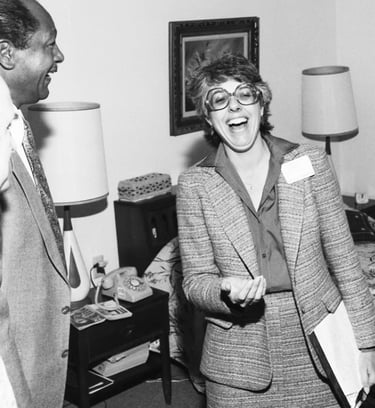
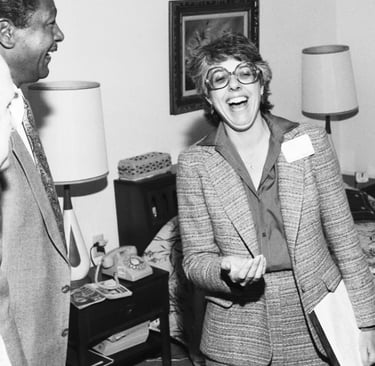
Janet with L.A. Mayor Tom Bradley, 1980s
Campbell Aging Resources
An independent community resource project. Not medical, legal or financial advice.
2026. All Rights Reserved.
Pages
Home
Resources
the long view
why we built this
getting organized
solo aging
caregiving
contact
(C) 2026 Campbell Aging Resources-Aging here shouldn't mean aging alone.
Coachella Valley — Full time and year-round